Sastaticket Funnel-Leak A/B Tests
On Pakistan's biggest travel site, the real price kept arriving too late. A card fee at the last step, foreign-transaction tax on the statement days later, and a call center that kept hearing one word: scammed. I ran three controlled A/B tests that moved the true price forward through the funnel. Method mix, mid-funnel progression, and repeat booking all went up, and fee complaints dropped 70%.

Sastaticket sells flights and hotels into a market that has been burned by hidden fees, so trust is the whole game. Three leaks ran straight through the funnel. On the payment page, card was the default method and a processing fee got added at the very end, so the amount people paid was higher than the price they had picked. When I listened to support calls, customers used the word scammed. Further up, people saw cheap fares on airlines' own sites, booked there, and only found the roughly 14% of withholding tax and bank fees on their statement, the same cost Sastaticket's local methods avoided. And on the card form itself, 9% of card payments were dying on avoidable typos: wrong number, wrong expiry, wrong CVV.
I treated all three as one problem. The true price was arriving too late to be trusted, so I moved it forward and made it legible at each step, and every change shipped as a controlled A/B test in Google Optimize rather than a hunch. On the payment page I put the exact rupee saving on the two no-fee methods, 1Bill and HBL. At flight search, and again at review, I surfaced the foreign-transaction cost people would quietly eat by booking elsewhere. On the card form I added field-level helper icons and a visible way to reach a human. I kept the honest cost in view too: the support option lifted conversion and raised call volume at the same time, and that trade-off was mine to own.
The price kept arriving too late to trust.
The first signal was in the call center. I sat and listened, and the same complaint kept coming back on the payment page: the final amount was higher than the price they had chosen, because a card fee got added at the end. People did not say the fee was unfair. They said it felt like a trick.
That reframed the whole funnel for me. This was not a pricing problem, it was a timing problem. The true price existed, it just showed up after people had committed, which is exactly when a surprise reads as a scam. So the throughline for everything after was simple: move the real price forward, and say it plainly.
Three tests, one funnel, one idea.
I ran three controlled tests in Google Optimize, each at a different step. On the payment page I put the actual rupee saving on the two no-fee methods, so picking 1Bill or HBL felt like keeping money rather than dodging a fee. No-fee method selection rose 40%, overall payment conversion 8%, and fee complaints fell 70%.
The other two moved the same honesty upstream and downstream: the true foreign-transaction cost at flight search, and clearer guidance plus a human on the card form. Flip between control and variant below to see exactly what changed at each step.
A/B test explorer
Three controlled tests, one funnel. Flip control and variant.
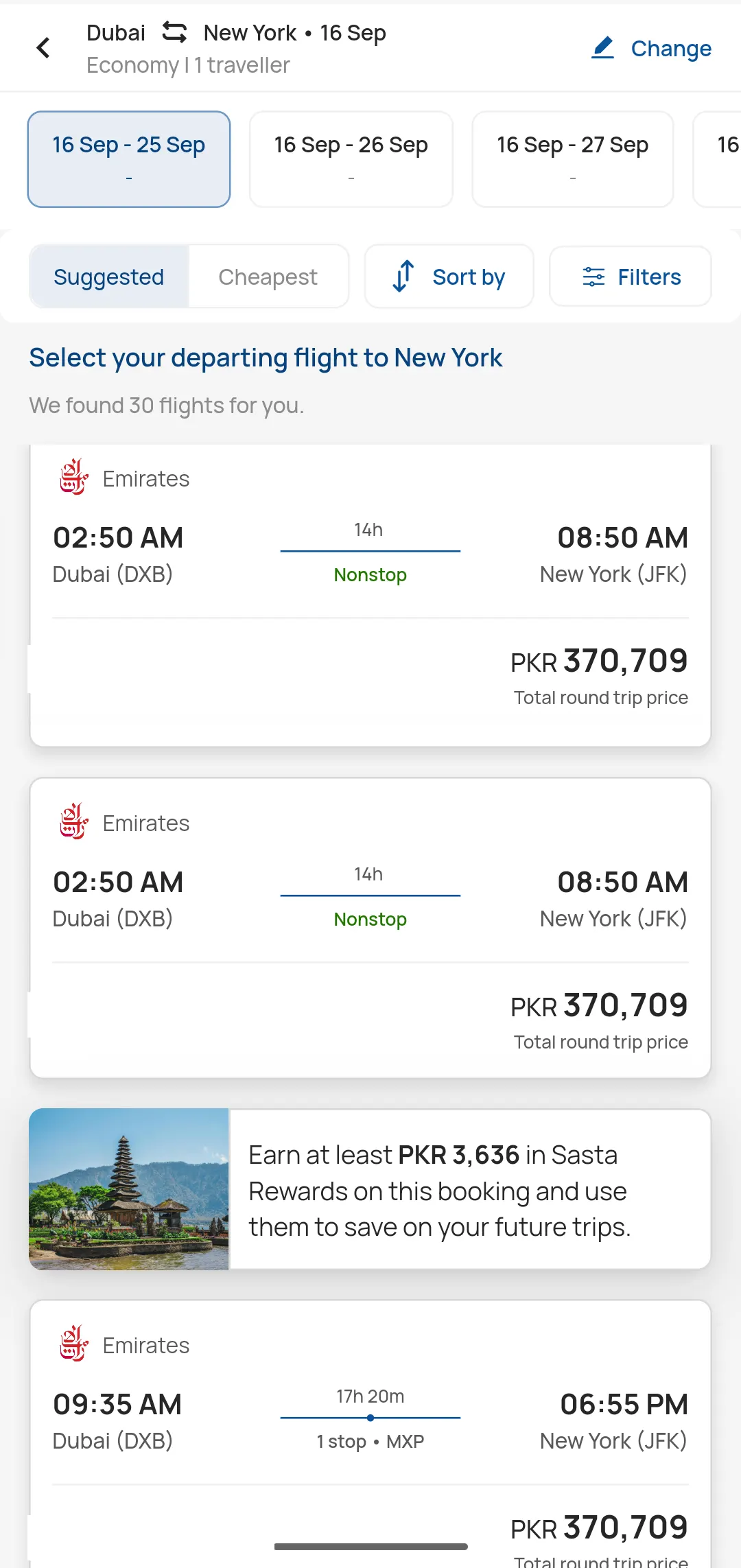
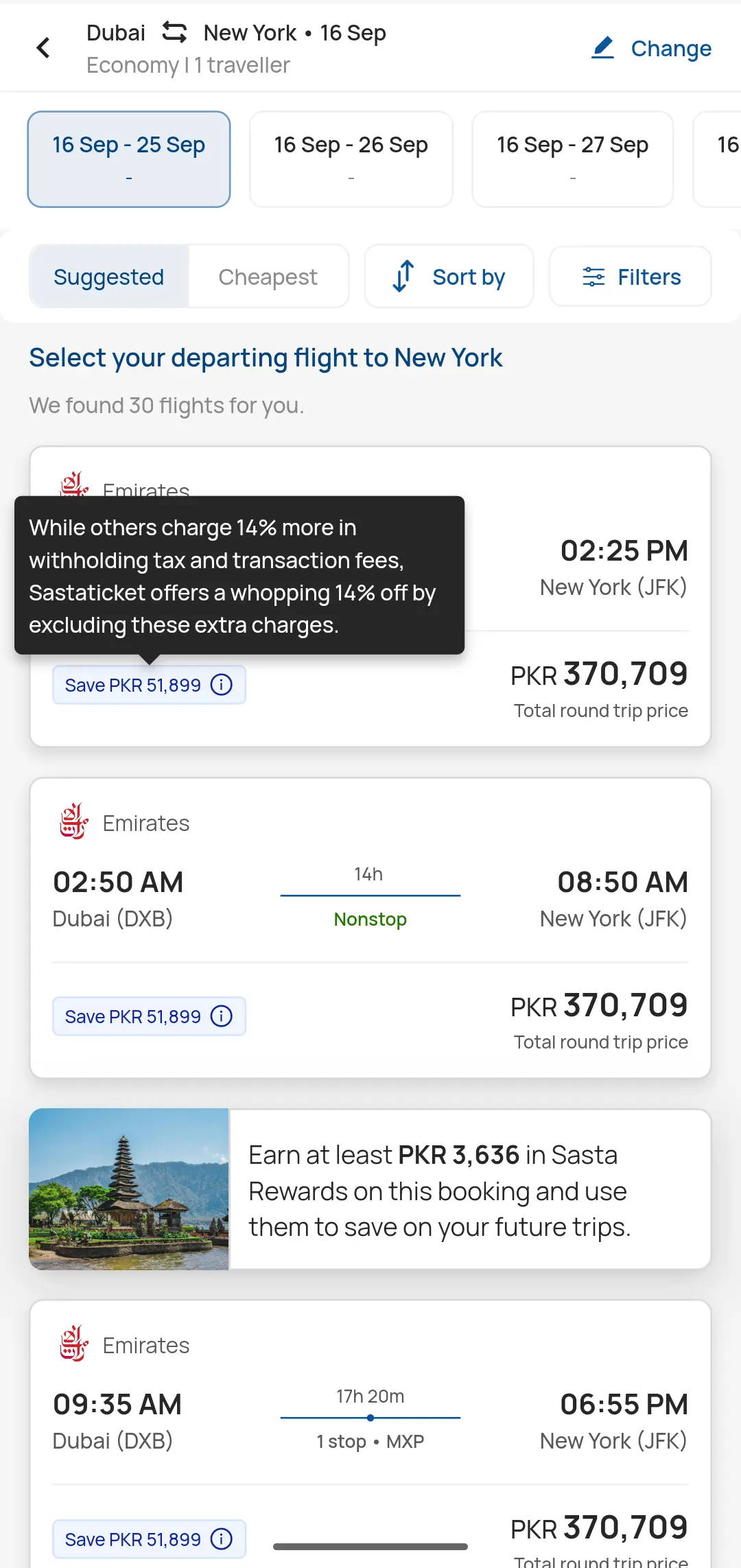
People compare on sticker price and pay the hidden 14% elsewhere. Show the true all-in cost at search and more of them move forward here.
- +28%
- On to passenger details
- ~14%
- Hidden card cost surfaced
If honesty converts at the end, it converts harder at the start.
The job people have at search is basic: know what this trip will actually cost me. They were failing that job elsewhere, seeing a cheap fare, booking, then finding roughly 14% in withholding tax and bank fees on the statement. For a non-filer, which is most cardholders here, that tax is real money they never claim back.
Sastaticket's local methods avoided that cost, so the edge was making it visible before the decision, not after. I tested the message on the search results and again on the flight-review step, and both won.
Mid-funnel progression · after surfacing the all-in price at search
+37% / +28%Once the hidden ~14% stopped being a statement-day surprise, people kept moving. Progression to the review step rose +37%, and on to passenger details +28%.
I shipped the win and named its cost.
On the card form, 9% of payments were dying on typos. A variant with helper text and info icons on the fields cut that to 2%. Alongside it I added a visible option to call for help, because a stuck payment is a stressful moment and people want a person, not another retry.
The support option lifted conversion 5%. It also raised calls tagged assist-payment by more than 20%. I could have buried that number, but it is the honest ledger of the decision: I traded some support load for completed payments and more trust, and I would make that trade again. Naming the cost is how you earn the next call.
Trust is a funnel metric, and it compounds.
The number I care about most is quieter than the conversion lifts: repeat booking rose 9% after these shipped. A surprise fee at the end of one trip is churn at the start of the next, so removing the surprise does more than convert today's booking, it earns the next one.
That is the loop I was really building. In a market where people expect to be nickel-and-dimed, being the site that shows the whole price first is not just a conversion tactic, it is why they come back and bring a friend.